While using filters, or frits, is an obvious approach to capturing beads in a fixed geometry within a flow channel, it fails rapidly, since filters become easily clogged. Valve-based systems are clumsy and can’t be miniaturized (Chandler 2000). Magnetic beads are expensive and can’t be optically probed.
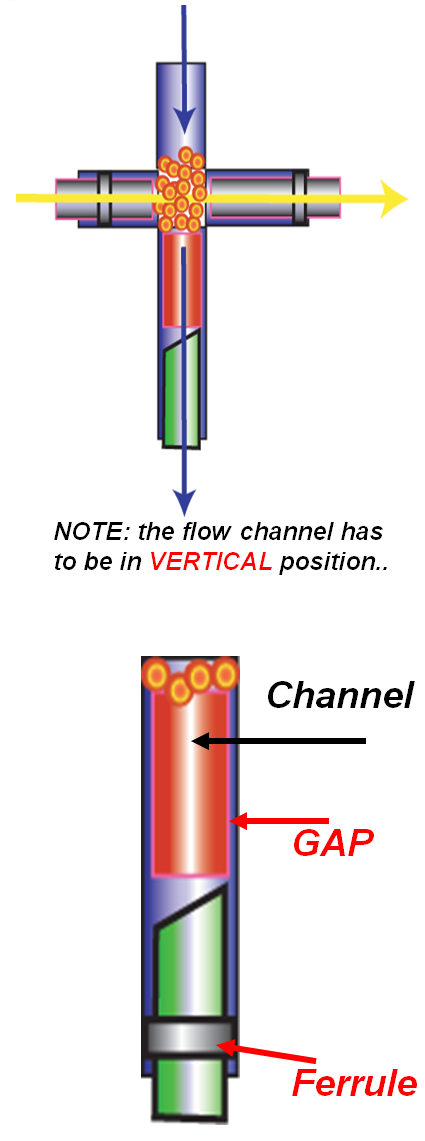
In the LOV channel or flow cell, beads are retained by a moving hollow plug (red) machined with a gap that allows liquids to pass around and through the plug while the beads are retained. This flow geometry is essential, since it allows even perfusion of beads retained in a well-defined space between the optical fibers.
The plug made of red color-coded PEEK tubing (Upchurch O.D 1.6 mm I.D. 100 μm) fits into the LOV channel that has been precisely machined to leave less than a 30 μm gap between the channel walls and the red tubing. This allows liquid to pass, while the beads (O.D 30 to 150 μm) are trapped on top of the plug. The tubing that holds the plug in place, is made of color-coded green PEEK tubing (Upchurch O.D. 1.6mm, I.D 800 μM) that has been cut at an angle, in order to reduce the flow resistance at the red/green tubing interface. The green tubing is held in place by a standard ferrule/nut Upchurch fitting, that prevents leaks from the LOV exit channel.
Capturing Beads for Spectroscopy
3.2.9.


The devil is in the details.
D.P.Chandler, F.J. Brockman, D.A. Holman, J.W.Grate & C.J.Bruckner-Lea, TRAC, 19, 314 (2000).